Awareness Campaign: Price vs. Value
Plattform Land is a South Tyrolean alliance dedicated to fostering vibrant rural communities and smart land use. It was founded in the fall of 2013 by the South Tyrolean Farmers’ Association and the Association of Municipalities. The platform’s goal is to preserve and enhance the quality of life in rural areas through collaboration among various stakeholders. To this end, it implements awareness-raising initiatives and projects aimed at sustainable development, active vacancy management, forward-looking renovation concepts, and smart land use.


At first glance, sealed surfaces often seem cost-effective. They create more immediately usable space, appear to be less expensive to construct, and supposedly require less maintenance for paths or paved areas. However, those who focus solely on these short-term benefits overlook the long-term consequences.
After all, where green space is lacking, the microclimate deteriorates, heat islands form, rainwater cannot infiltrate as easily, and the risk of flooding increases. At the same time, habitats for plants and animals are lost. What seems efficient today often leads to higher costs tomorrow—for example, for cooling, drainage, or future climate adaptation measures.
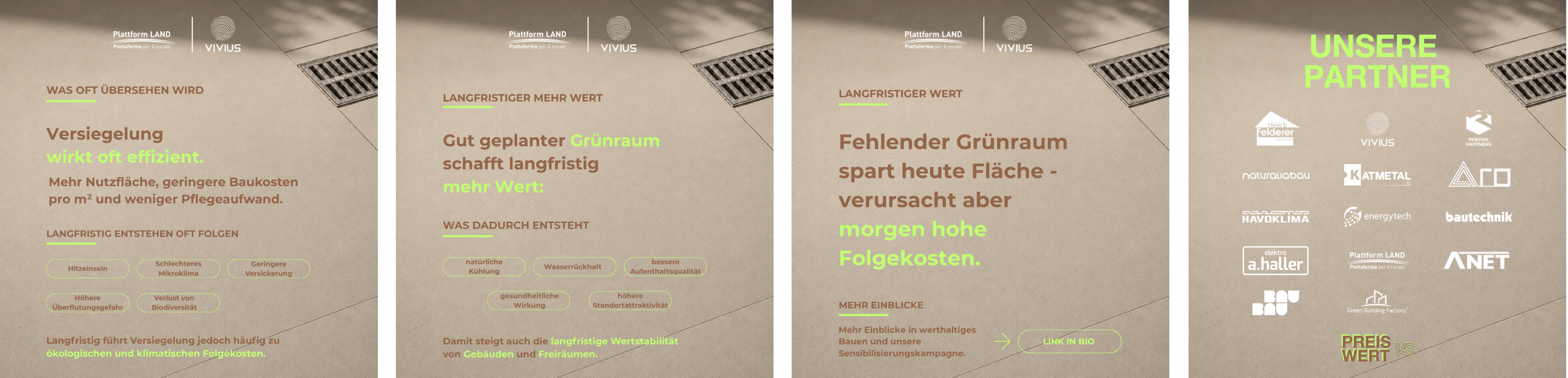
Well-planned green space, on the other hand, creates added value that goes far beyond its design. It naturally cools the environment, retains water, improves the quality of life, and promotes health and well-being. At the same time, it enhances a location’s appeal and contributes to the long-term value stability of buildings and open spaces.
True-cost accounting therefore requires that green space not be viewed as leftover land, but rather as part of forward-looking planning. While a lack of green space may save land today, it leads to ecological, functional, and economic costs in the long run.
That is why those who build for the future plan not only in terms of square meters, but also in terms of climate, water management, quality of life, and resilience. Green space is not a secondary consideration. It is part of a sound, long-term building decision.
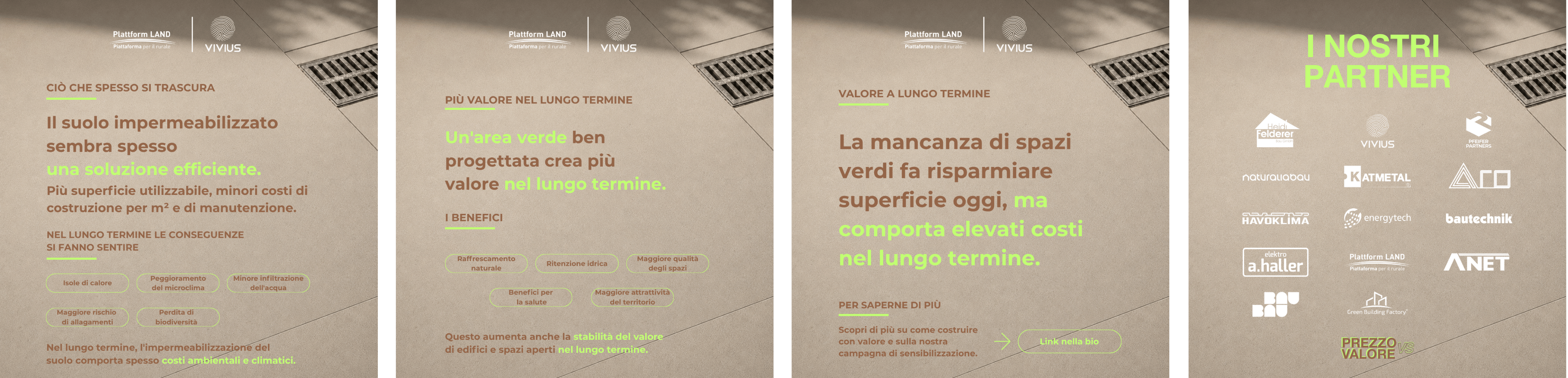
What appears today to be additional paved usable space could become a problem tomorrow: more heat, reduced infiltration, a higher risk of flooding, and rising costs for cooling and drainage. Green space, on the other hand, provides natural climate protection, improves the quality of the environment, and enhances the long-term quality of the location.
Less soil sealing means greater value for people, communities, and the future.
Green space is not a luxury.
It is part of a sustainable construction decision.
Anyone interested in sustainable construction and de-sealing will find two helpful resources here. The renovation advisory service provides support for climate-friendly renovation measures, while the “Turn Gray into Green” competition offers incentives to transform sealed surfaces into valuable green spaces.
Additional information:
Renovation Consulting: https://www.klimaland.bz/mission-klimaland/beratungen/
From Gray to Green: https://www.plattformland.org/2026/05/04/wettbewerb/
Get exclusive access to the free white paper from the “Price vs. Value” awareness campaign.
It provides a concise summary of all 13 topics, including background information, real-world examples, and valuable insights for making sustainable construction decisions.
Simply enter your email address to download it right away.


