Awareness Campaign: Price vs. Value
Katmetal specializes in metal fabrication, sheet metal work, and sun and weather protection, offering everything from steel structures, facades, stairs, roofing, and fall protection systems to pergolas and shade structures. Sustainability is also a key issue in this industry—precisely because steel is an energy-intensive material with a corresponding carbon footprint. As a founding member of VIVIUS, Katmetal takes responsibility and actively seeks ways to operate in a more resource-efficient manner, gain new perspectives, reevaluate existing processes, and develop innovative approaches in collaboration with others.



At first glance, shading often seems like an extra expense. It involves higher upfront costs, requires careful planning, and is still frequently viewed as optional. However, as summer heat intensifies, it becomes increasingly clear that effective shading is not an extra, but rather an integral part of sustainable building quality. After all, its true value becomes apparent in everyday life.
Well-planned shading reduces overheating, improves indoor climate, and noticeably increases thermal comfort. It lowers the need for active cooling, reduces operating costs, and protects health and well-being—especially during long heat waves.
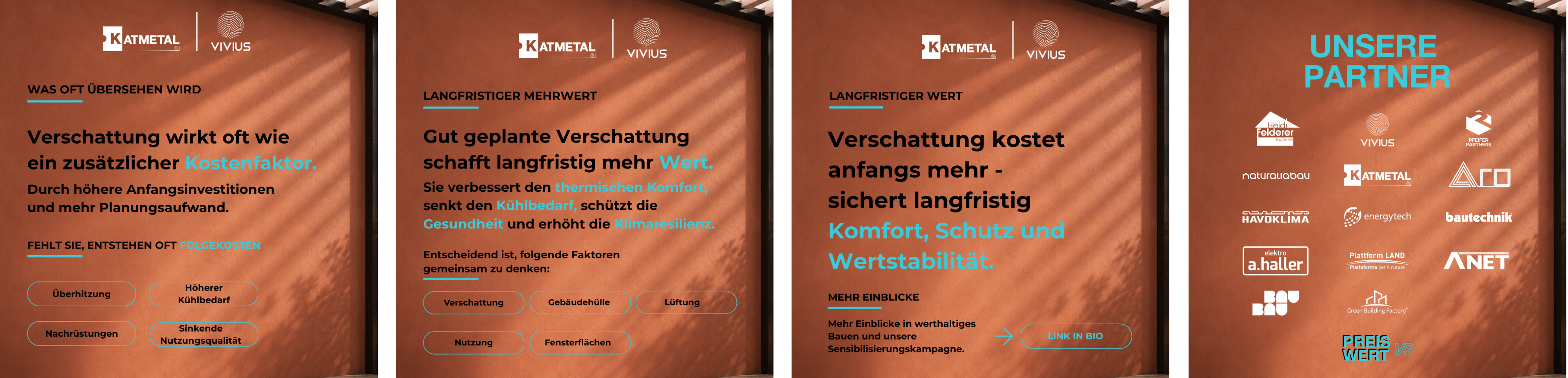
Therefore, true cost accounting requires taking into account the consequences of failing to plan ahead. Where there is a lack of shading, cooling needs, energy consumption, and retrofitting costs all increase. Rooms become less pleasant to be in, and buildings lose their usability. What is saved today often has to be compensated for tomorrow through technically and financially costly measures.
What matters most is not any single measure, but rather the interplay of the entire building. Shading is most effective when window areas, orientation, the building envelope, ventilation, thermal mass, and greenery are considered as a whole. Not every solution works everywhere—but every building needs a solution to cope with rising summer heat.
That’s why investing in shading today means investing not only in comfort but also in climate resilience. Buildings that remain comfortable and usable even at high temperatures retain their value better over the long term, are more adaptable, and are better prepared for the future.
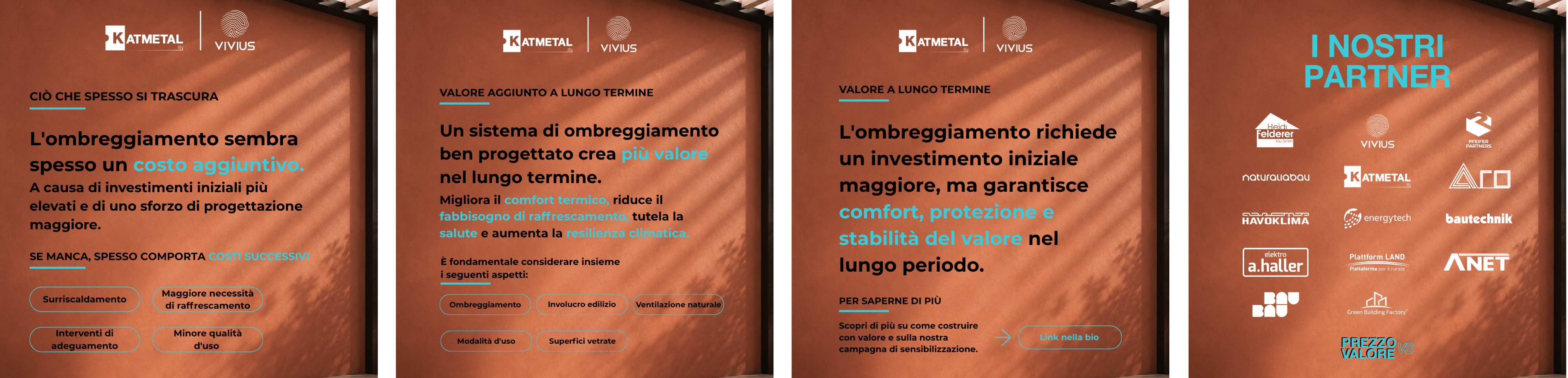
What seems like an extra today will become a necessity tomorrow. Effective shading protects against overheating, reduces cooling needs, and improves everyday comfort. It is therefore not just a matter of comfort, but also of cost-effectiveness and health.
Those who take summer heat into account early in the planning process create buildings that remain more resilient, functional, and valuable over the long term. After all, climate resilience doesn’t start with air conditioning—it starts with shade.
Climate resilience doesn't start with air conditioning—it starts with shade.
A lack of shade will cost you comfort, energy, and value down the road.
Get exclusive access to the free white paper from the “Price vs. Value” awareness campaign.
It provides a concise summary of all 13 topics, including background information, real-world examples, and valuable insights for making sustainable construction decisions.
Simply enter your email address to download it right away.


